
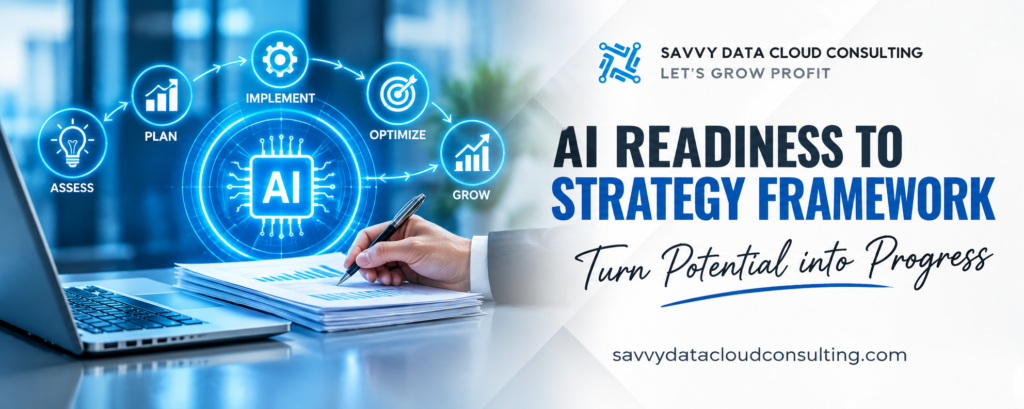
How Businesses Assess AI Readiness, Identify Operational Gaps, Score AI Opportunities, and Build a Prioritized Implementation Roadmap
Artificial intelligence is transforming how businesses operate, make decisions, serve customers, and compete in increasingly digital markets. From automating repetitive tasks to improving forecasting and personalizing customer experiences, AI offers opportunities to increase efficiency and create measurable business value. However, adopting AI without understanding organizational capabilities, operational challenges, and strategic priorities can lead to wasted investments and disappointing results.
Businesses need a structured approach to determine whether they are prepared to implement AI, which processes would benefit most, and what resources are required to achieve successful outcomes. An AI readiness to strategy framework helps organizations evaluate their current capabilities, uncover operational gaps, prioritize promising use cases, and translate business objectives into actionable initiatives. By combining readiness assessments, opportunity scoring, and strategic planning, companies can move beyond experimentation and establish a practical path toward AI adoption.
This blog covers AI readiness assessment, operational gap identification, opportunity scoring, and roadmap development to help businesses prioritize AI initiatives and achieve measurable outcomes.
Evaluate Organizational Capabilities Before Adopting AI
Businesses must first determine whether they have the resources, infrastructure, and internal support needed for successful AI adoption. A business AI maturity assessment establishes a baseline by evaluating existing data management, automation, analytics, and AI capabilities.
Organizations should examine five key areas:
- Data readiness: Accuracy, accessibility, and security of business data.
- Technology infrastructure: Existing software, cloud platforms, and system integrations.
- Workforce skills: AI literacy, technical expertise, and change management capabilities.
- Governance and security: Data privacy, regulatory compliance, and responsible AI practices.
- Leadership alignment: Executive support and alignment with business objectives.
This assessment helps businesses identify capability gaps, recognize existing strengths, and establish realistic priorities. Understanding these factors before investing in AI solutions enables organizations to make informed decisions and build a stronger foundation for successful implementation.
Find Where Daily Operations Fall Short
Businesses must identify operational bottlenecks that limit efficiency and growth. These may include repetitive tasks, slow decision-making, inaccurate forecasts, or disconnected data systems.
An AI gap assessment compares existing processes with desired business outcomes to identify areas where AI can improve performance. For example, finance teams may spend hours processing invoices manually, while sales teams struggle with fragmented customer data.
Organizations should review workflows, analyze performance metrics, and gather employee feedback to uncover these challenges. They must also distinguish problems that require AI from those that can be solved through simpler process improvements. Linking each gap to measurable outcomes, such as reduced costs, fewer errors, and improved productivity, helps businesses prioritize meaningful improvements.
Discover Practical Opportunities Across Business Functions
Once operational gaps are understood, the next step is identifying where AI can deliver meaningful improvements. AI opportunity mapping helps organizations connect business challenges with potential AI applications across departments.
Common opportunities include:
- Customer service: AI assistants can answer routine questions, categorize requests, and support service representatives.
- Sales and marketing: Predictive analytics can identify promising leads, while AI tools can support audience segmentation and campaign analysis.
- Finance: Intelligent automation can assist with invoice processing, anomaly detection, and financial forecasting.
- Human resources: AI can support internal knowledge searches, employee onboarding, and routine administrative tasks.
- Supply chain: Predictive models can improve demand forecasting, inventory planning, and disruption monitoring.
Each opportunity should have a clearly defined problem, intended users, required data, expected outcome, and potential risks.
Businesses should also consider whether existing software already provides the necessary capabilities or whether a custom solution is justified. This step of the AI readiness to strategy framework connects operational priorities with realistic AI applications, helping decision-makers develop a focused portfolio of potential projects.
Rank AI Initiatives by Value, Feasibility, and Risk
Identifying promising use cases is only part of the process. Businesses must determine which initiatives deserve investment first, particularly when budgets, technical resources, and employee capacity are limited.
AI opportunity scoring provides a consistent way to compare potential projects using key criteria:
- Business impact: Potential improvements in revenue, productivity, customer experience, and cost efficiency.
- Implementation feasibility: Availability of the required data, technology, and expertise.
- Investment requirements: Estimated development, integration, training, and maintenance costs.
- Risk exposure: Potential privacy, security, compliance, and operational risks.
- Strategic alignment: The extent to which the initiative supports long-term business objectives.
Businesses can assign weighted scores, such as 1 to 5, based on each criterion’s importance. For example, invoice automation with clear efficiency benefits and manageable risks may take priority over a complex predictive system requiring significant infrastructure changes.
However, high scores should not override essential data protection, human oversight, and accountability requirements. The goal is to identify initiatives that balance meaningful business value with realistic implementation demands.
Translate Priorities Into a Phased Implementation Plan
With the strongest opportunities identified, organizations can develop an AI transformation roadmap that outlines the sequence of activities needed to move from assessment to deployment. A practical plan typically includes three stages.
Phase 1: Build the Foundation
Address data-quality issues, establish security and governance policies, train employees, and assign clear project responsibilities.
Phase 2: Test Promising Use Cases
Launch controlled pilot projects, establish baseline metrics, and evaluate results against predefined success criteria before committing to wider implementation.
Phase 3: Scale Successful Solutions
Integrate proven AI applications into broader operations and monitor their performance to maintain reliability and efficiency.
An effective AI strategy roadmap should define budgets, timelines, milestones, project owners, and measurable outcomes. Moreover, an AI consulting framework for small businesses can help startups or newly launched firms identify affordable solutions, address capability gaps, and prioritize investments based on available resources. This phased approach reduces implementation risks while supporting sustainable business growth.
Measure Results and Improve the Strategy Continuously
AI implementation requires ongoing evaluation to ensure it delivers the expected benefits. Businesses should track relevant performance indicators, such as customer response times, processing costs, error rates, lead conversions, and employee productivity.
Comparing these metrics against initial benchmarks helps organizations measure progress and identify areas for improvement. They should also monitor employee adoption, output quality, system reliability, and potential risks.
Regular reviews enable businesses to refine underperforming solutions, expand successful initiatives, and adjust investments as priorities change. Revisiting the AI readiness to strategy framework ensures that AI initiatives remain aligned with evolving business goals and continue delivering measurable value.
Conclusion
Successful AI adoption begins with understanding where a business stands, what prevents it from performing at its best, and which opportunities offer the greatest potential value. By evaluating organizational capabilities, identifying operational gaps, scoring use cases, and establishing a phased implementation plan, businesses can make more informed decisions about AI investments. A structured AI readiness to strategy framework also helps align technology, people, and business objectives while creating a foundation for sustainable improvement.
For organizations seeking expert guidance in this process, they can rely on us at Savvy Data Cloud Consulting. We offer corporate AI training and consulting services to help businesses strengthen their capabilities and approach AI adoption with greater clarity. To learn more about our services, visit our website now.